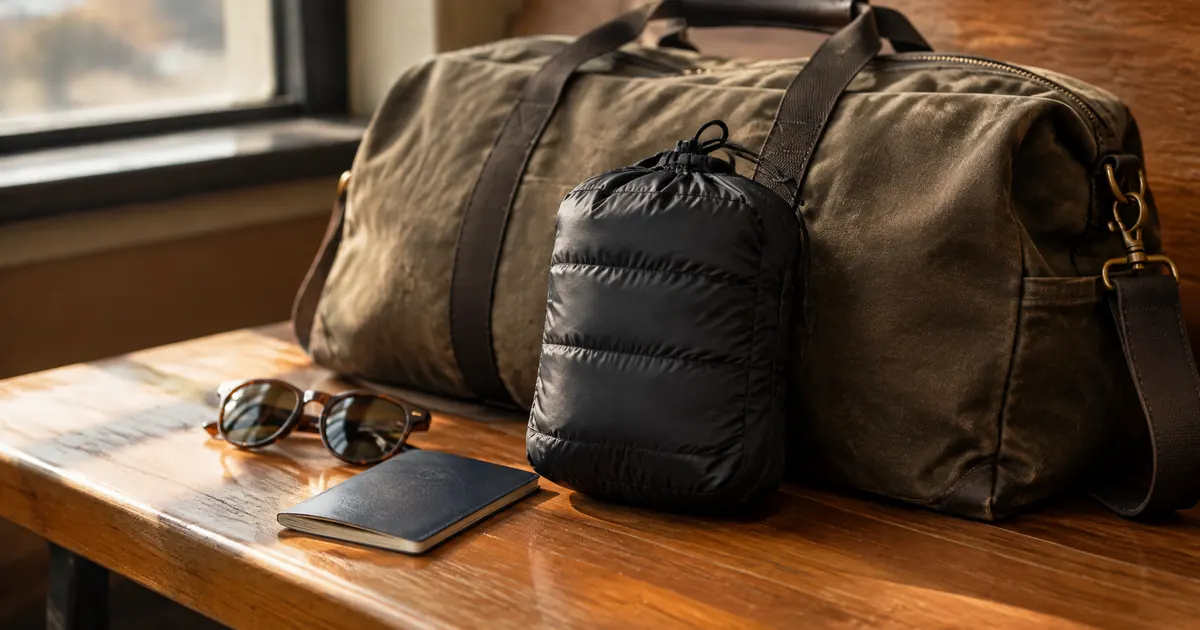
A packable jacket is a promise: real warmth or real weather protection that disappears into your bag when you don't need it. Kept, that promise is one of the best value propositions in outerwear. Broken, it's a $60 disappointment that stops packing down by March. The difference is visible in the details - if you know where to look.
What "packable" actually means
Any jacket can be crammed into a bag. A true packable is engineered for it: fabrics and insulation chosen to recover from compression, a cut that survives being stuffed, and often a stash pocket to pack into. The industry has no legal standard for the word, so the buyer's job is checking the specs that matter.
Spec one: the insulation
Packable insulation comes in two families:
- Down (duck or goose): measured in fill power - loosely, how lofty the down is for its weight. 600 is serviceable, 700-800 is excellent. Down wins on warmth-to-weight and compressibility, but loses all insulation value when soaked and needs careful washing.
- Synthetic fill: polyester insulation that keeps warming when wet, dries fast, costs less, and handles being stuffed daily without complaint. Modern synthetics have closed most of the warmth gap. For commuters and daily stuffers, synthetic is the pragmatic choice - it's what we build our packable puffers around.
Also check fill weight (grams of actual insulation) when listed. A "packable puffer" with 30g fill is a wind layer; 80-120g is genuine cold-weather insulation. Listings that don't state fill weight are usually hiding a low number.
Spec two: the shell fabric
Shell fabrics are measured in denier (D) - the thickness of the threads. 10D-15D fabrics are ultralight and silky but fragile; 20D-40D survives backpacks, seatbelts, and daily abuse. For a jacket that lives in a commuter bag, 20D or higher is the durability floor. Our packable shells sit at 30D for exactly this reason.
Spec three: the baffles
Baffles are the stitched chambers that hold insulation in place. Two constructions exist:
- Sewn-through: shell stitched directly to lining at each baffle. Lighter and cheaper, but every stitch is a cold spot. Fine for mild conditions.
- Box baffles (internal walls): fabric walls between shell and lining eliminate stitched-through cold spots. Warmer per gram of fill, slightly heavier, noticeably better in real cold.
Run your hand inside a quality puffer: if you can feel every seam ridge through the shell, it's sewn-through. That's acceptable in a light layer, not in a jacket you're trusting at 30°F.
Spec four: the details that predict lifespan
- Zips: a smooth, midweight zipper with a garage (a fabric stop at the top) signals quality. Tiny zips with sharp carriage action are the first thing to fail.
- Stash pocket: the best packables pack into their own pocket - a built-in stuff sack you can't lose. Check that the pocket's zipper is reversible or protected so the packed jacket doesn't snag itself.
- Elastic vs. cinch hems: cinch cords seal warmth better; elastic is simpler. Either is fine, but a hem that's already slack out of the box means the elastic is cheap.
- Seam logic: for rain shells, seams should be taped or welded. If the listing doesn't say "taped" or "sealed" and the price is low, assume it isn't - and it will leak exactly where your backpack straps sit.
Matching the jacket to the job
- Commuter insurance: a synthetic packable puffer that lives in the bag October through April. Durability spec beats weight spec.
- Travel: same puffer doubles as a pillow in flight; add a featherweight windbreaker for the rain-prone itinerary.
- Wet climates: prioritize the sealed packable rain shell over insulation - you'll layer warmth underneath anyway.
- Sport and trail: accept lighter fabrics (10-15D) and treat the jacket gently; weight savings are real when you're the engine.
Caring for a packable
Compression is a tool, not a lifestyle: a jacket kept stuffed 24/7 will loft less over time. Shake it out overnight when you can. Wash synthetic fills on cold, tumble low with tennis balls to restore loft, and never iron the shell. The full routine is in our care guide.
The test of a packable is boring and reliable: stuff it, forget it, and be glad it's there when the forecast turns. Buy on specs, not adjectives - and every spec we promise, we print. Browse the puffers and quilted collection or the rain and wind lineup to compare.