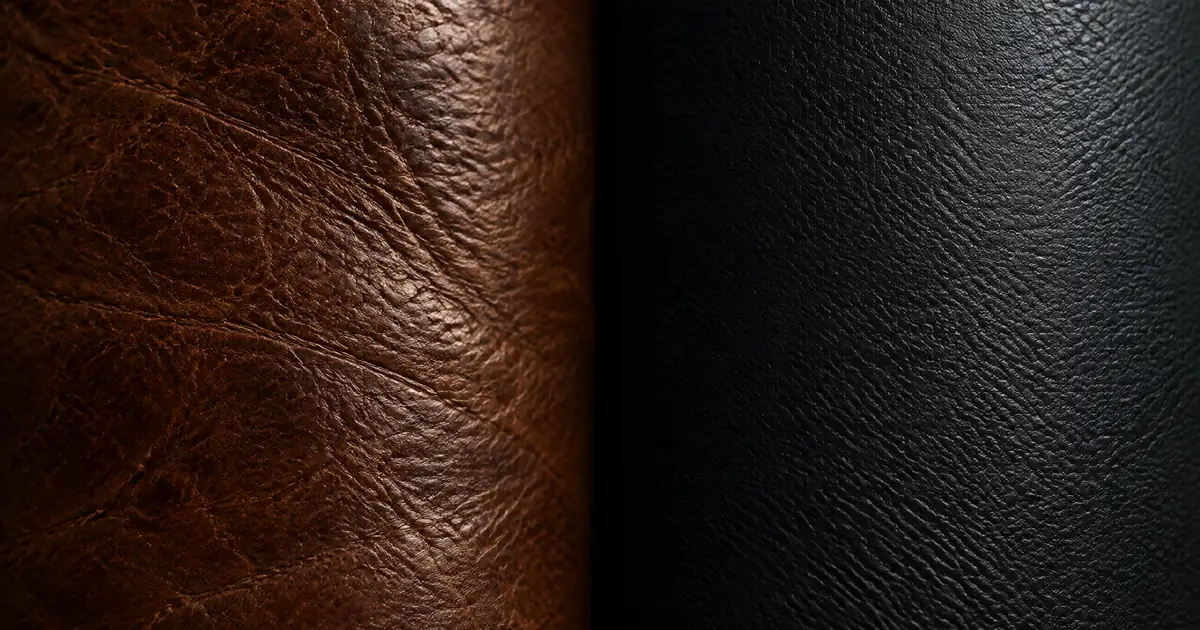
Faux leather has a reputation problem, and honestly, it earned some of it. Cheap vinyl jackets from the 90s cracked in a season and peeled onto everything you owned. Modern polyurethane faux leather is a different material - but the honest answer to "is it as good as real leather?" is: it depends entirely on what you value. Here is the comparison without the marketing from either side.
What each material actually is
Real leather is animal hide, tanned and finished. Quality varies enormously - a full-grain jacket and a bonded-leather jacket share a label and nothing else.
Faux leather in quality outerwear is polyurethane (PU) - a polymer face bonded to a fabric backing, usually polyester. Better PUs are flexible, breathable at a basic level, and color-stable. Vinyl (PVC) is the cheaper, stiffer cousin that gave faux leather its bad name; we don't use it.
Durability: the honest version
Real leather, properly cared for, lasts decades and develops a patina many people love. It also has real variation: scars, grain differences, stretch over time.
Quality PU faux leather lasts years of regular wear - our biker and racer styles are tested through hundreds of wear cycles - but it will not develop patina, and its lifespan is measured in years, not decades. The failure mode is also different: leather usually softens and stretches; faux leather eventually surfaces fine cracks, most often at flex points like elbows.
Practical translation: if you want a jacket to hand down, buy real leather from a maker you trust. If you want a sharp jacket for the next several seasons at a fraction of the price, quality faux leather is the rational choice - and the faux leather styles in our collection are priced so that cost-per-wear works out in your favor fast.
Break-in and comfort
Real leather is stiff when new. A quality leather jacket needs weeks of wear to mold to your body - some people love that ritual, others just find it uncomfortable.
Faux leather is ready on day one. A faux leather biker jacket drapes and moves like itself from the first wear, with no break-in period and no stiffness at the elbows. For most people this is the single biggest day-to-day advantage.
Care and maintenance
| Real leather | Faux leather (PU) | |
|---|---|---|
| Everyday cleaning | Damp cloth, then condition | Damp cloth - that's it |
| Conditioning | Required, 2-3x per year | Not required |
| Machine wash | Never | Never |
| Water spots | Can stain permanently | Wipes off |
| Storage | Breathable bag, cool dry | Hang, avoid crushing |
Faux leather is genuinely lower-maintenance. The one rule that matters: heat is the enemy. No radiators, no irons, no hot car dashboards. Our full jacket care guide covers the routine that keeps PU looking new for years.
Cost: the part nobody frames honestly
A quality real-leather jacket starts around $300 and climbs past $1,000 quickly. A quality faux leather jacket lives between $80 and $150. The real question is cost-per-wear: a $120 faux leather moto jacket worn 80 times a year for three years costs half a cent per wear. The leather jacket only wins that math if you genuinely wear it for a decade - which many people buy intending to do and few actually do.
Ethics and environment
Faux leather involves no animal products, which is the primary reason most buyers choose it. The environmental picture is genuinely mixed: PU is plastic-based and not biodegradable, while leather tanning is resource-intensive and chemically heavy. There is no clean winner here - only trade-offs you get to weigh. What we commit to is honesty on the label: our jackets say "faux leather" plainly, in the name and on the tag, so you always know what you're wearing.
So which should you buy?
- Buy real leather if: you want a decades-long companion, you enjoy break-in and conditioning, and the budget is comfortable.
- Buy quality faux leather if: you want the look and structure today, zero maintenance, no animal products, and a price that makes owning two or three styles reasonable. Start with a charcoal racer or a black bomber - the two silhouettes that work with the widest range of wardrobes.
Whichever camp you're in, buy from listings that name the material honestly. You should never have to guess what's on your back.